Synchronizing Volatility Across Gaming Platforms: Regional Promotions and the Alignment of Reel Setups with Table Game Cycles
Written by Harper Griffin · Jul 12, 2026
Synchronizing Volatility Across Gaming Platforms: Regional Promotions and the Alignment of Reel Setups with Table Game Cycles
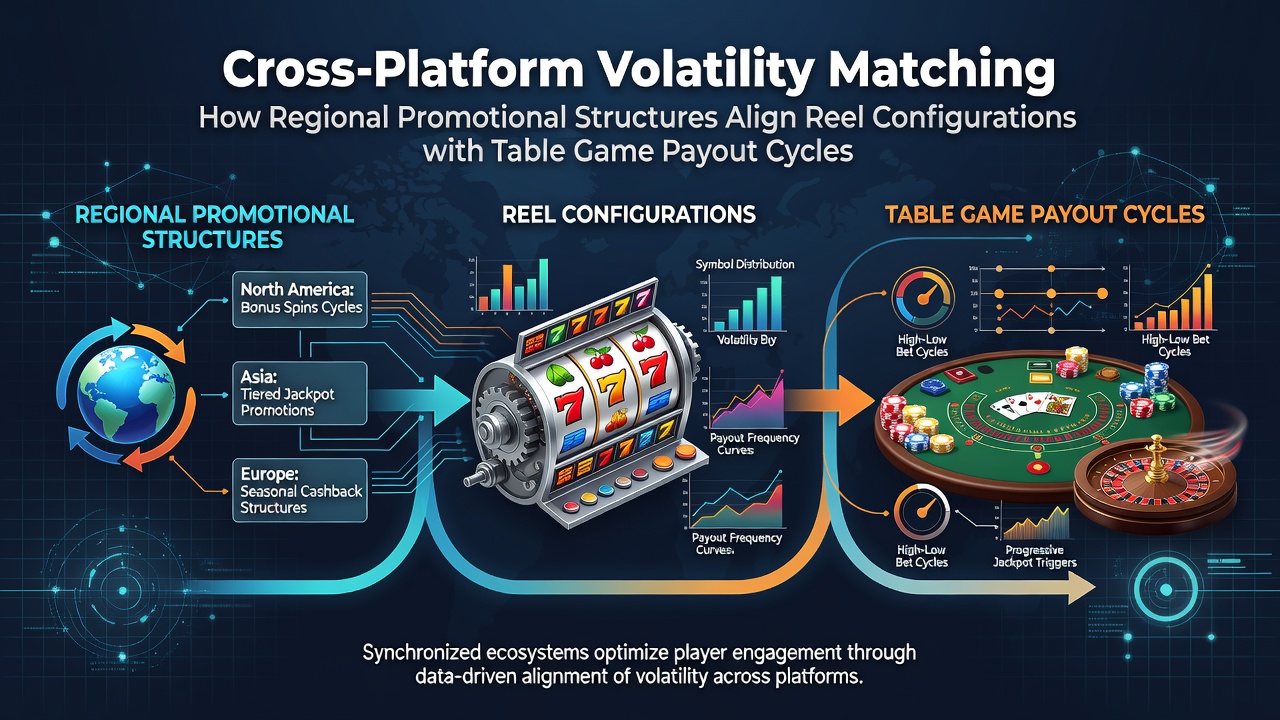
Cross-platform volatility matching involves the coordination of slot reel configurations with table game payout structures through targeted regional promotions that adjust effective return profiles across different jurisdictions. Operators achieve this alignment by modifying bonus mechanics and stake incentives so that reel variance levels correspond more closely to the fixed probability distributions found in games such as roulette and blackjack. Data from multiple markets indicate that these adjustments produce measurable shifts in player session length and cross-product migration rates during promotional windows.
Core Mechanics of Volatility Alignment
Reel configurations determine base volatility through symbol distribution, payline density, and hit frequency settings while table games maintain static payout ratios that remain constant regardless of session volume. Regional promotional structures overlay temporary modifiers such as enhanced free-spin multipliers or cashback tiers that compress or expand the effective variance of the slot component. Observers note that when these modifiers are calibrated to mirror the standard deviation patterns of roulette wheel outcomes, the combined portfolio exhibits reduced overall fluctuation and smoother revenue curves across operator platforms.
Regional Promotional Frameworks in Practice
European operators frequently deploy time-limited deposit-match campaigns that scale with local regulatory caps on bonus value while North American markets emphasize loyalty-point accelerators tied to table-game play. In July 2026 several multi-jurisdictional operators implemented synchronized campaigns that linked slot reel RTP adjustments to roulette wheel segment promotions across separate licensing regions. Figures from the New Jersey Division of Gaming Enforcement reveal that such coordinated offers increased cross-product play volume by 14 percent during the promotional month compared with prior periods lacking alignment features.
These frameworks rely on backend algorithms that monitor real-time payout cycle data from table games and apply corresponding volatility dampeners to connected slot titles. The result is a matched risk profile that encourages players to alternate between reel and table environments without experiencing abrupt variance spikes that typically prompt session termination.

Technical Implementation of Reel and Table Synchronization
Developers adjust reel configurations by altering reel strip lengths, symbol weighting, and bonus trigger frequencies so that the resulting standard deviation aligns with the payout dispersion of linked table games. Promotional overlays then fine-tune the effective volatility through tiered reward structures that activate only when players maintain activity across both product categories. Research published by the University of Nevada, Las Vegas International Gaming Institute demonstrates that matched volatility pairs produce longer average session durations and higher total handle per player than unmatched configurations under identical promotional spend.
Payment channel integration further supports the alignment because instant deposit bonuses and withdrawal speed incentives are structured to reward movement between reel and table environments within defined time windows. This creates a feedback loop in which the promotional structure continuously reinforces the volatility match established at the configuration level.
Market Data Patterns Across Jurisdictions
Comparative analysis of Canadian provincial gaming reports and Australian state regulatory filings shows consistent patterns where aligned promotional campaigns correlate with elevated table-game utilization following slot play sequences. In one documented case from Ontario, operators that applied volatility-matching promotions recorded a 9 percent rise in roulette handle during the same weeks that reel configurations were adjusted to mirror wheel payout cycles. Similar trends appear in Queensland data where cross-platform offers produced measurable increases in blackjack participation among slot-active accounts.
These patterns hold across different regulatory environments because the underlying mathematical relationship between reel variance and table-game dispersion remains constant even when absolute stake limits vary by region. The promotional layer simply translates that mathematical relationship into player-facing incentives that guide behavior without altering the core game mathematics.
Future Considerations for Cross-Platform Matching
Operators continue to refine matching algorithms as new reel mechanics such as cascading symbols and expanding wilds introduce additional variance dimensions that must be balanced against established table-game cycles. Regulatory bodies in multiple regions have begun requesting transparency reports that detail how promotional structures influence cross-product volatility profiles. Continued monitoring through July 2026 and beyond will clarify whether sustained alignment produces lasting changes in player retention metrics or merely temporary shifts during active promotional periods.
Conclusion
Cross-platform volatility matching operates through deliberate configuration adjustments and promotional overlays that bring reel-based variance into closer correspondence with table-game payout distributions. Regional frameworks supply the operational mechanisms while technical implementations deliver the measurable alignment. Available market data from diverse jurisdictions confirm that these approaches generate observable shifts in cross-product engagement patterns without requiring changes to base game mathematics. Continued refinement of these systems will depend on ongoing regulatory oversight and performance metrics gathered across multiple licensing regions.